Keeping receipts and documents: How long in Switzerland?
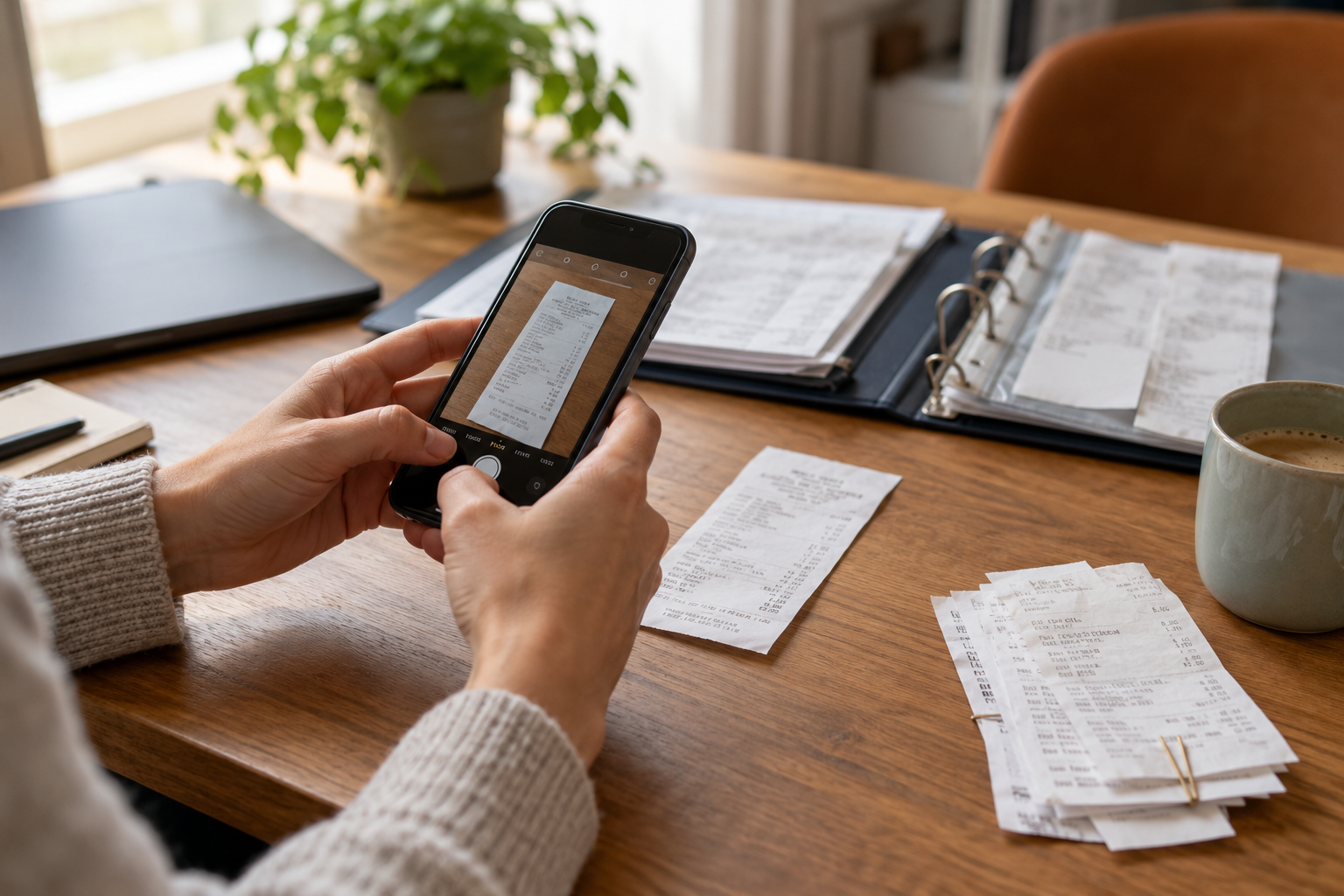
Over the course of a year, a lot of receipts and documents pile up. What do you need to keep, and for how long? In short: for private individuals in Switzerland, there is no general retention period. But there are good reasons to keep certain documents for several years. For self-employed people and companies, on the other hand, there are clear obligations.
Private individuals: No fixed period, but good reasons
Tax law explicitly requires a fixed retention period of ten years only for self-employed people and legal entities (Art. 126 para. 3 DBG, the Federal Act on Direct Federal Tax). The tax guide of the canton of Zurich also mentions such a period only for documents from self-employment.
Still, it is worth keeping documents. You must do everything towards the tax office so that a complete and correct assessment is possible, and present documents and certificates on request (Art. 126 para. 1 and 2 DBG). An assessment is the tax office's decision on how much tax you owe. If you cannot prove a deduction, you risk it not being accepted.
Taxes: Why ten years makes sense
Two periods from the Federal Act on Direct Federal Tax (DBG) are important:
- Limitation period for assessment: The right to assess a tax generally expires five years after the end of the tax period. The period can be interrupted and then starts again. But after 15 years at the latest, it is over (Art. 120 DBG).
- Supplementary tax (Nachsteuer): If it later turns out that an assessment was incomplete, the tax office can charge a supplementary tax. The right to start such a procedure expires ten years after the end of the tax period (Art. 152 para. 1 DBG). According to the ESTV (Federal Tax Administration), the same period applies to cantonal and municipal taxes.
Recommendation: Keep the documents for your tax return for ten years from the end of the tax year concerned. That way you can back up your details if questions come up.
Example: You keep the documents for your 2025 tax return until the end of 2035.
Warranty and purchase receipts
When you buy something, the seller is liable for defects. These warranty claims usually become time-barred two years after the item was delivered (Art. 210 para. 1 OR). If you buy from a business as a private individual, this period may not be shortened to less than two years, or less than one year for used items (Art. 210 para. 4 OR). If the seller took on longer liability, the longer period applies (Art. 210 para. 1 OR). A manufacturer's guarantee follows its own terms.
So keep the purchase receipt and guarantee certificate at least as long as the warranty or guarantee runs.
Health insurance and health costs
Medical costs you pay yourself can be deducted from your taxes to the extent that they exceed 5 percent of your income reduced by certain deductions (Art. 33 para. 1 lit. h DBG). Benefit statements from your health insurer, doctor's and pharmacy bills therefore belong to your tax documents. Treat them the same as your other tax documents.
Rent and service charges
You should keep the rental contract, the handover report and the proof of your rental deposit for the entire rental period and afterwards until everything has been settled and the deposit has been paid back.
For service charges, the landlord must let you see the receipts on request (Art. 257b para. 2 OR). Claims for rent become time-barred after five years (Art. 128 no. 1 OR). So it makes sense to keep rent payments and service charges statements (Nebenkostenabrechnungen) for at least five years.
Proof of payment in general
A receipt proves that you paid. As long as a claim is not time-barred, it can in principle be enforced: generally ten years (Art. 127 OR), for certain claims such as craftsmanship work or medical treatment five years (Art. 128 OR). For that long, it is worth keeping proof of payment.
Your own property
If you sell a house or flat held as private assets, the profit is taxed with the cantonal property gains tax (Grundstückgewinnsteuer). The taxable amount is the amount by which the sale proceeds exceed the investment costs. Investment costs are the purchase price plus expenses (Art. 12 para. 1 StHG). So you should keep the purchase contract and documents on investments until the property is sold and the profit has been taxed with legal force. What exactly counts as an expense is regulated by your canton.
Self-employed people and companies: ten years is mandatory
For business books, accounting records, the annual report and the audit report, there is a retention obligation of ten years. The period starts at the end of the financial year (Art. 958f para. 1 OR). For self-employed people, the ten-year period also follows from tax law (Art. 126 para. 3 DBG). Sole proprietorships (Einzelfirmen) with less than CHF 500'000 in turnover in the last financial year only have to record income, expenses and their financial position (Art. 957 para. 2 OR), but must still keep the documents for them.
VAT (MWST): If you are liable for VAT, you keep the documents until the absolute limitation of the tax claim, that is ten years after the end of the tax period (Art. 70 para. 2 and Art. 42 para. 6 MWSTG). For documents needed to calculate the input tax correction (Einlageentsteuerung) and private use of immovable property, that is real estate, a period of 20 years applies (Art. 70 para. 3 MWSTG). This concerns companies liable for VAT, not private owners.
Overview: What, how long, why
| What | How long | Why |
|---|---|---|
| Documents for your tax return (salary statement, certificates, proof of deductions) | Recommendation: 10 years from the end of the tax year | Supplementary tax procedure possible for up to 10 years (Art. 152 DBG) |
| Health insurance statements, doctor's and pharmacy bills | Same as tax documents | Deduction for medical costs (Art. 33 para. 1 lit. h DBG) |
| Purchase receipts and guarantee certificates | At least as long as the warranty or guarantee, by law usually 2 years | Rights in case of defects (Art. 210 OR) |
| Rental contract, handover report, deposit receipt | Entire rental period, until everything is settled | Proof when moving out |
| Rent payments, service charges statements | Recommendation: at least 5 years | Rent claims become time-barred after 5 years (Art. 128 OR) |
| Other proof of payment | 5 or 10 years, depending on the claim | Statute of limitations (Art. 127 and 128 OR) |
| Purchase contract and investment documents for your own property | Until after sale and taxation | Property gains tax (Art. 12 StHG) |
| Business books and accounting records (self-employed, companies) | Mandatory: 10 years from the end of the financial year | Art. 958f OR, Art. 126 para. 3 DBG |
| VAT documents | Mandatory: up to 10 years after the end of the tax period | Art. 70 para. 2 MWSTG |
| VAT documents on real estate (input tax correction, private use) | Mandatory: 20 years | Art. 70 para. 3 MWSTG |
Keeping documents digitally
For private individuals, the law does not prescribe a specific form. In everyday life, a legible scan or a PDF is usually enough as proof. Make sure the files are fully legible, sensibly named and backed up. It is best to also keep originals of important contracts and certificates on paper.
For companies: business books and documents may be kept electronically if they match the business transactions and can be made legible at any time (Art. 958f para. 3 OR). The details are set out in the Ordinance on Keeping Business Records (GeBüV). Among other things, it requires that changes to the documents can be detected (Art. 3 GeBüV). If changeable storage media such as hard drives are used, technical protection measures are needed, for example digital signatures and time stamps, as well as documented processes and logs (Art. 9 GeBüV).
Frequently asked questions
Do I have to keep documents at all as a private individual?
There is no general legal period. But the tax office can ask for documents (Art. 126 para. 2 DBG), and receipts prove payments. That is why it makes sense to keep important documents.
Is a photo or scan of the receipt enough?
For private individuals, the law does not prescribe a form. In everyday life, a clearly legible scan is usually useful proof. For a guarantee, it is worth checking the guarantee terms.
From when do the ten years count for taxes?
The supplementary tax period runs ten years from the end of the tax period (Art. 152 DBG). So for the 2025 tax year, until the end of 2035.
Does the 20-year period apply to my own home?
No. The 20 years under Art. 70 para. 3 MWSTG concern companies liable for VAT. For your own home, what matters most are the documents for the property gains tax when you sell.
Stay on top of things with Fina
Fina, the AI assistant in CasaFin, reads your invoices, payment reminders and receipts, files them neatly and shows you what is due soon. She prepares the documents you need for your tax return. Fina never sends anything by herself, you decide. Fina does not replace legal or tax advice.
Try Fina free for 14 days
CasaFin files your documents neatly, shows deadlines and prepares your tax documents. Done in ten minutes.
Try Fina free for 14 days or see LifetimeCasaFin editorial team, reviewed by Michaela Boppart
- DBG, Art. 33, 120, 126, 152 - Fedlex
- ESTV: Supplementary taxation (Nachbesteuerung)
- Tax guide canton of Zurich 2025
- Swiss Code of Obligations (OR), Art. 210, 257b, 957, 958f, 127, 128 - Fedlex
- StHG, Art. 12 (property gains tax) - Fedlex
- MWSTG, Art. 42, 70 - Fedlex
- GeBüV (Ordinance on Keeping Business Records) - Fedlex