Setting up a sole proprietorship (Einzelfirma) in Switzerland: the complete guide 2026
The sole proprietorship (Einzelfirma) is the simplest legal form in Switzerland. You need no start-up capital, no notary, and you can get going right away. In return, you are liable with all your private assets. Here you will learn step by step what you need to do.
Who is a sole proprietorship right for?
For everyone who works self-employed on their own: consulting, graphic design, coaching, crafts, therapy, online retail. If your business grows strongly or you want to separate the risk from your private assets, switching to a GmbH (limited liability company) is worth it later.
Step 1: Register with the compensation office (SVA)
The most important step. Register with your canton's compensation office (Ausgleichskasse) as self-employed. It checks whether you really are self-employed, for example whether you have several clients, work at your own risk and issue invoices in your name.
As a self-employed person, you pay AHV, IV and EO (Swiss social security) yourself. The contribution rate is up to 10 % of your profit; for low incomes, a lower rate applies.
Step 2: Choose a company name
The name of your sole proprietorship must include your surname, for example «Keller Grafik» or «Laura Keller Coaching». Additions like «GmbH» or «AG» are not allowed.
Step 3: Commercial register (mandatory from CHF 100'000 turnover)
From an annual turnover of CHF 100'000, you must register your sole proprietorship in the commercial register. Below that, registration is voluntary. It protects your company name in the canton and looks professional to clients.
Step 4: VAT (MWST) (mandatory from CHF 100'000 turnover)
From CHF 100'000 turnover per year, you must register for VAT with the ESTV (Federal Tax Administration). Below that, it is voluntary. Registering voluntarily can be worth it if you buy a lot, because you can then reclaim the input tax.
Step 5: Check permits
Some professions need a permit, for example catering, health professions or taxi services. Ask your municipality or the canton.
Step 6: Open a business account
A separate account is not required by law. Still, we recommend it: this way you keep private and business clearly apart, and bookkeeping and your tax return become much easier.
Step 7: Sort out insurance
As a self-employed person, you are not automatically insured against accidents. Sort out accident cover through your health insurer or a voluntary UVG accident insurance. The pension fund (2nd pillar, BVG) is also voluntary for self-employed people. Think about pillar 3a: without a pension fund, you can pay in much more.
Taxes: How your sole proprietorship is taxed
A sole proprietorship has no tax return of its own. The profit is taxed together with your other income in your private tax return. You can deduct business expenses such as materials, office, further training or part of your phone if you have receipts.
Bookkeeping: What do you have to keep?
Up to CHF 500'000 turnover, simple bookkeeping is enough: income, expenses and financial position. Keep all receipts for 10 years.
Checklist
- Register with the compensation office (SVA)
- Company name with your surname
- Commercial register from CHF 100'000 turnover
- VAT from CHF 100'000 turnover
- Check permits
- Open a business account
- Sort out accident insurance and pillar 3a
- Organise bookkeeping and receipts from the start
Frequently asked questions
How much does it cost to set up a sole proprietorship?
Registering with the compensation office is free. An entry in the commercial register costs a one-off fee that varies by canton.
Can I run a sole proprietorship alongside my job?
Yes. Many people start on the side. But check your employment contract to see whether side activities must be reported.
When is a GmbH worth it?
When your profit rises significantly, you hire employees or you want to protect your private assets. Get advice on this from a fiduciary (Treuhänderin).
General information, not legal advice. For your individual case, a professional can help.
Keep your sole proprietorship under control with Fina
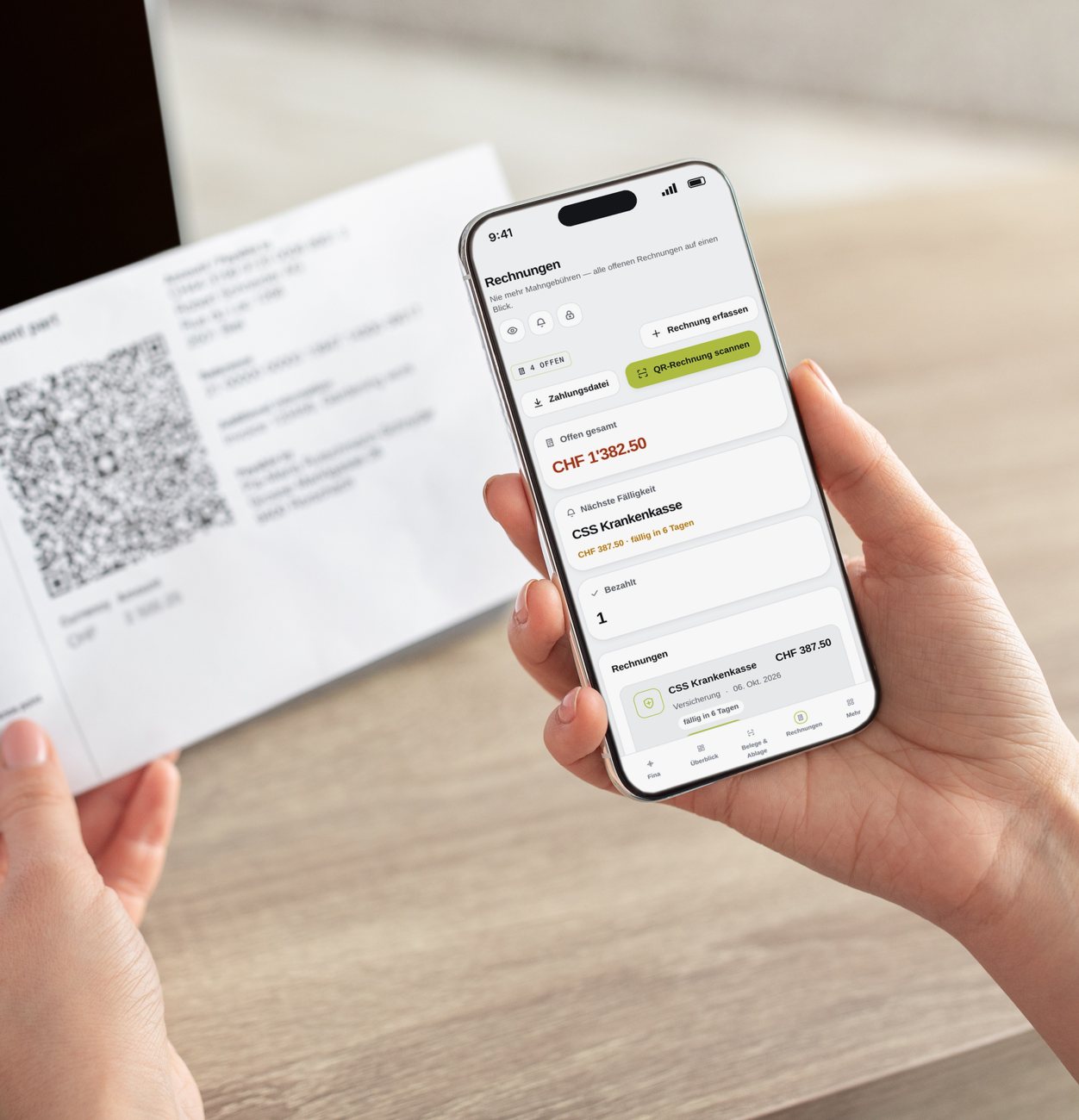
With CasaFin you have private and business in one place, cleanly separated. Fina reads your invoices and receipts, files them correctly, keeps track of deadlines and prepares everything for your tax return.
Try Fina free for 14 days or secure Lifetime until 31 December